![Seer Logo White.png]](https://knowledge.seerdata.ai/hs-fs/hubfs/Seer%20Logo%20White.png?height=50&name=Seer%20Logo%20White.png)
What is a Dataset?
A Dataset is a collection of data organised around a shared theme or subject area.
An example of a Dataset is the Australian Early Development Census (AEDC) — a national collection of data relating to early childhood development. This Dataset brings together multiple measures across key areas and can be explored by users on the Explore Data page.
Datasets in Self-Service Data Collection
Within Self-Service Data Collection, there are different ways a Dataset can be structured, depending on how the data is sourced.
Aggregate (file-based) Datasets
When a Dataset is created by uploading aggregate data (for example, via a file), it can be structured into different areas of interest using Dataset Templates.
Dataset Templates allow aggregate data to be:
-
Organised into logical groupings
-
Collected or imported consistently
-
Queried and explored in a structured way
This use of Dataset Templates applies only to aggregate, file-based datasets.
URL-based Datasets
Datasets created from URLs follow a different structure and do not use Dataset Templates. These Datasets are managed and queried based on their source configuration rather than template-based data collection.
How do I create a Dataset?
To create a Dataset:
-
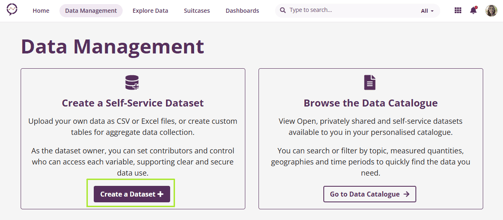
From the top navigation, go to Data Management.
-
Select Create a Dataset + under Create a Self-Service Dataset.
-
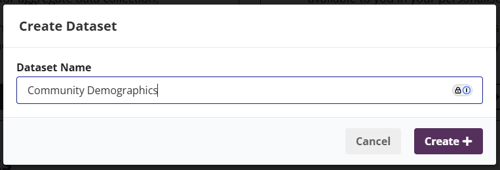
Enter a name for your Dataset.
-
Click Create to finish.
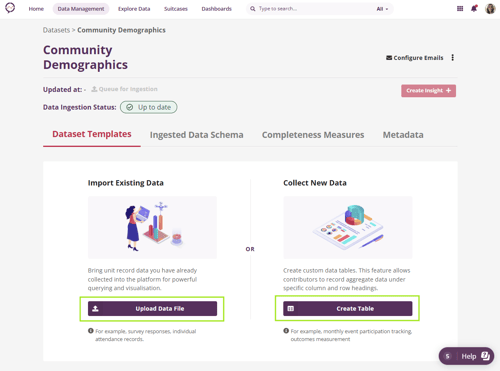
Once your Dataset is created, you can:
-
Import existing data (for aggregate datasets), or
-
Collect new data using Dataset Templates (for aggregate datasets
Related articles
-
Learn how to import existing data
-
Find out how to create a new Data Table
Why this matters
Understanding how Datasets work helps ensure data is collected, organised, and explored in the right way from the start. Clear Dataset setup supports reliable aggregation, easier analysis, and more confident use of Insights over time.