![Seer Logo White.png]](https://knowledge.seerdata.ai/hs-fs/hubfs/Seer%20Logo%20White.png?height=50&name=Seer%20Logo%20White.png)
What is a Category?
A Category is a specific value or grouping within a Variable. Categories define the options that data can be recorded against, helping give structure and meaning to a dataset.
While a Variable describes what kind of information is being captured, Categories describe the possible values within that Variable.

An example
If the Variable is State or Territory, its Categories might include:
-
New South Wales
-
Victoria
-
Queensland
-
Western Australia
.png?width=304&height=489&name=Screenshot%202026-01-08%20at%204.31.04%20pm%20(1).png)
Each Category represents a distinct option that data can be associated with. When contributors enter data, they are recording values against these Categories.
Categories in data entry
Categories appear in Data Tables as the labels that organise rows or columns, depending on how the Schema is designed.
For example:
-
A Variable with multiple Categories may be displayed as rows, with one row per Category.
-
A Variable with fewer Categories may be displayed as columns, making data entry faster and clearer.
The Categories themselves do not change the data being collected — they simply define how that data is grouped and organised.
Categories in Explore Data
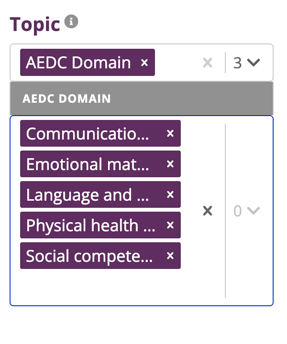
Categories are also used in the Explore Data tool and are found as Topics in a dataset.
When a Variable (for example, the AEDC Domain) is selected:
-
Its Categories become available to filter or group data
-
Users can compare results across Categories
This allows aggregated data to be explored in a way that supports insight, learning, and decision-making.
Why this matters
Clearly defined Categories help ensure data is entered consistently across contributors and time periods.